We are getting very good at asking the wrong AI question in schools.
The question usually sounds like this: Did the student use AI?
And I get it. That question feels clean. It fits inside a policy. It gives adults something to enforce. It lets us put work into one of two buckets: allowed or not allowed, honest or dishonest, student work or robot work.
The problem is that learning does not fit neatly in those buckets anymore.
A student can use AI and think deeply. A student can use AI and think almost not at all. A student can write every word by hand and still not understand the idea. A student can use a chatbot for feedback, tear half of it apart, rebuild the answer, defend the choices, and walk away more capable than when they started.
Same tool. Very different learning.
That is the door.
Intro to NotebookLM, live with Jason & Ronda
Tuesday, June 16 · 7:00 PM Eastern · inside the AI Launch Pad
The same walk-through Ronda Swartz and I gave at the Fever Conference this month: how to turn your own sources into a research assistant you can actually trust. Bring a real classroom question.
Agentivism
A new learning theory for the age of AI. Not “students used AI.” Not “students did not use AI.” The better question is whether AI helped build durable human capability.
The merit badge has the right instinct.
This week on School’s Out Saturdays, I talked with Bryon Haverstick from Sagamore Council about Scouting’s new AI Merit Badge.
And the more I sat with that conversation, the more I kept thinking about something schools already know but sometimes forget when technology enters the room:
A badge is not awarded because a kid watched a tool work. A badge is awarded because the kid can show something.
That is a very different lens.
The badge model is not perfect, and I am not saying every classroom should suddenly become Scouts with Chromebooks. Please don’t make that your plan. But there is a useful signal here.
Scouting does not usually stop at exposure. It asks for evidence. Demonstrate the knot. Explain the safety rule. Complete the project. Teach someone else. Show the skill in the wild.
Schools need the same instinct with AI.
Because the final product is getting less trustworthy as evidence of learning. A clean essay does not prove the student wrestled with the argument. A perfect slide deck does not prove the student understands the content. A correct answer does not prove the student can reason through the process.
AI did not create that problem. It just put a spotlight on it and handed it a microphone.
The theory has a name now.
Lixiang Yan and Dragan Gašević recently proposed a learning theory called Agentivism. The plain-English version is this:
Learning in the AI age means students build durable human capability while using AI selectively, checking its work, rebuilding the output into their own understanding, and eventually doing more with less help.
That lands for me.
Not because schools need one more academic term floating around a committee room. We have plenty of fog already. It lands because Agentivism names the thing educators are trying to protect.
The goal is not AI-free schoolwork. The goal is not AI-polished schoolwork. The goal is a student who can use the tool without disappearing inside it.
That means the student still knows what was delegated. The student can verify what came back. The student can reconstruct the idea in their own words. The student can transfer the skill when the support is reduced.
That is the receipt.
The Agentivism Receipt: four things worth asking students to show
1. Delegation
What did you ask AI to do, and why was that the right part to hand off?
2. Verification
What did you check, compare, question, correct, or reject?
3. Reconstruction
How did you rebuild the answer so it became your understanding, not just the tool’s output?
4. Transfer
What can you do now with less help than you needed at the beginning?
This changes the school AI argument.
A lot of schools are still stuck in the permission stage.
Can students use AI for brainstorming? Can they use it for outlines? Can they use it for grammar? Can they use it for research? Can they use it at home if the district tool is blocked? Can they use it if they cite it? Can they use it if everyone pretends they didn’t?
Those questions matter. But they are not enough. Agentivism pushes us toward a better question:
What part of the assignment is supposed to grow inside the student?
Once you ask that, the AI decision gets clearer.
If the assignment is supposed to help students practice claim-evidence-reasoning, then maybe AI can help them generate bad examples to critique, but it should not quietly build the entire argument for them.
If the assignment is supposed to help students understand slope, then maybe AI can explain the concept three different ways, but the student still needs to solve, explain, and transfer the pattern.
If the assignment is supposed to help students prepare for a healthcare internship, then AI might help them rehearse patient communication, but the student still needs to speak clearly, notice risk, and adapt when the script breaks.
The tool can support the practice. It cannot be allowed to quietly steal the rep.
Beginner’s Mind
Imagine a student uses AI to write a beautiful paragraph about photosynthesis.
Looks great. Vocabulary is strong. Sentence flow is better than usual. The paragraph has that slightly too-smooth chatbot shine, like a hotel lobby where nobody has ever spilled coffee.
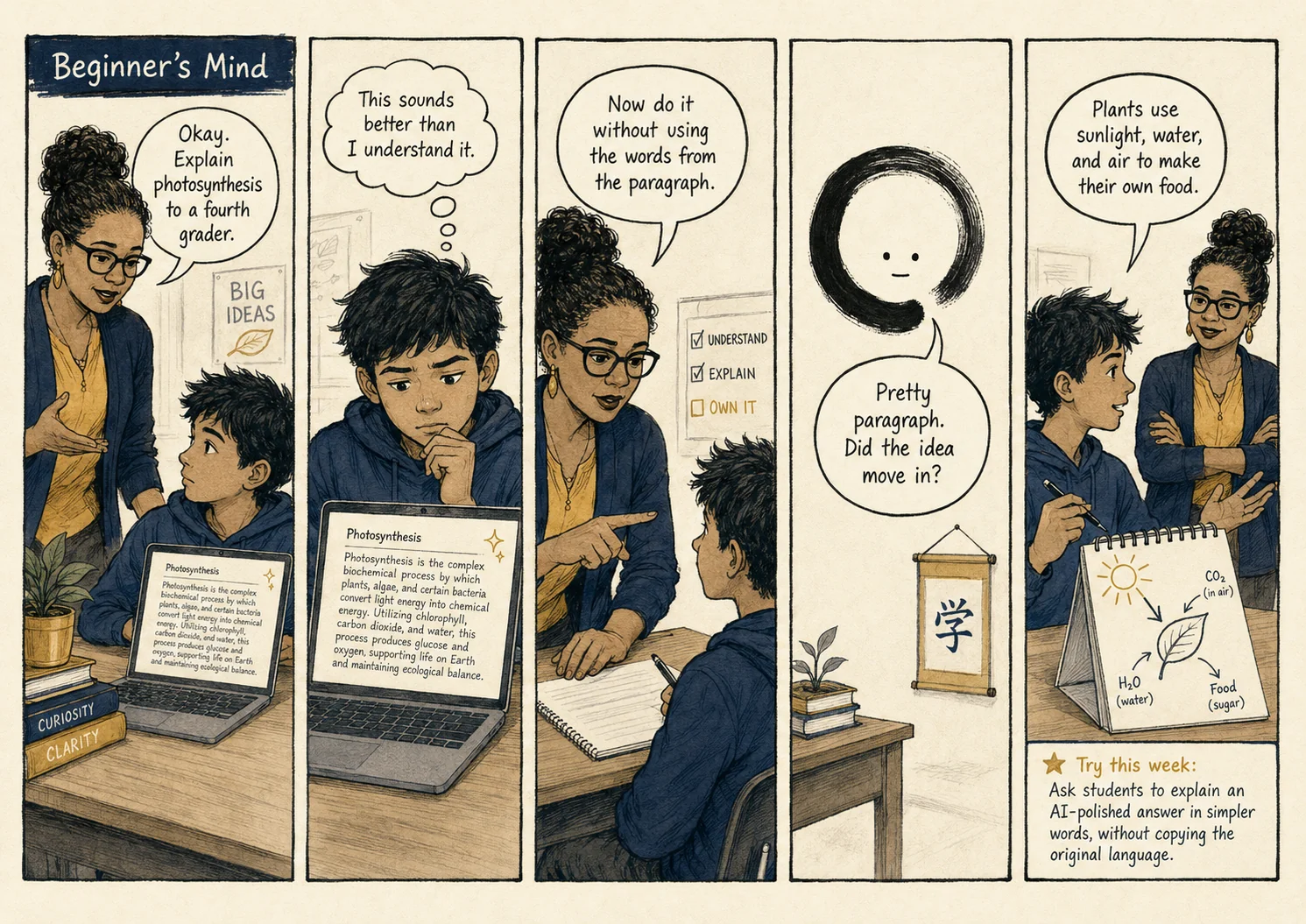
Beginner’s Mind · Issue 4 · The receipt is the learning.
That is not a gotcha. That is a learning check.
If the student can explain it, revise it, apply it to a plant in the school garden, and answer a follow-up question, great. AI may have helped. The student still grew.
If the student cannot explain it at all, then the work is not evidence of learning. It is evidence of access.
Access matters. But access is not readiness. We already covered that bridge. Now we need receipts.
Add one AI receipt to one assignment.
Do not rewrite the unit. Do not summon a task force. Do not make a rubric that needs its own assistant principal.
Take one assignment you already have and add this at the bottom:
AI Use Receipt
- What did AI help you do?
- What did you check or verify?
- What did you change, reject, or rewrite?
- What can you now explain or do without the tool?
Four questions. Five minutes. Nothing fancy.
But now the student has to bring back more than a finished answer. They have to bring back evidence that learning happened.
The adult move
The adult move is not to panic every time a student opens a chatbot. The adult move is also not to clap because the chatbot made the work prettier. The adult move is to ask where the thinking went.
Did the student keep the goal? Did the student set the criteria? Did the student notice the weak answer? Did the student check the claim? Did the student rebuild the idea? Did the student transfer the skill when the training wheels came off?
That is where AI readiness starts to look less like a tool policy and more like education.
Just say’n.
Go Deeper
This week on School’s Out Saturdays I talked with Bryon Haverstick from Sagamore Council about Scouting’s new AI Merit Badge and what it looks like when youth organizations start treating AI literacy as something students can practice, demonstrate, and teach. Watch it here: Scouting’s New AI Merit Badge.