I did something last week that still feels a little ridiculous to type out.
In about ninety minutes one morning, I got through what I would honestly estimate was eighty to a hundred hours of work. Not with one clever chatbot doing one clever thing. With seven AI agents, working together in one shared space, while I sat in the chair I have come to believe is the right seat for a human on a team like that. The editor's chair. We will get there. First, the week that refused to sit still.
Market Pulse
If you tried to keep up with AI news last week and felt behind, you were not behind. You were human. In a span of days, OpenAI shipped GPT-5.6, Z.ai released GLM-5.2, Meta put out Muse Spark 1.1, and SpaceXAI teamed up with Cursor to train Grok 4.5 together. That last one is a partnership, by the way, not an acquisition.
And then the one that actually made me sit up. Anthropic's Fable 5 and Mythos 5 got caught in U.S. government export controls and had to be redeployed. Read that again slowly if you run a business on rented intelligence.
Here is the part that matters for folks like us. The everyday professionals, the nonprofits, the small shops running real work with no research lab in the back room. Forget which model won the week. The question that actually pays your bills is this: what happens to you when the model you built your whole workflow around gets changed, gets pulled, or gets priced out from under you?
If the U.S. government can pull a model, and my entire business runs on that one model, then I built the problem myself.
Call it doom if you want. I am about as far from a doomer as they come, and this is just good sense. The genie is out of the bottle and I want to use it. I also do not want my whole operation to hinge on one company having a good week.
The Data Concept
Model routing and local models, in plain English
Two words got thrown around a lot last week. Let me demystify them, because they are the practical answer to that vendor-dependence worry, and neither one asks you to write a line of code.
Model routing is just a smart traffic cop. Instead of sending every job to the same expensive model, you set a simple rule. The hard, high-stakes work goes to your best model, the quick and cheap work goes to a lighter one, and if your first choice is down, the job reroutes to a backup. You have done this your whole life. You do not call the same specialist for a headache and a heart surgery.
A local model is one that runs on hardware you control. Your laptop, your server, your building. It is usually not the smartest model on the market. It is the one nobody can pull out from under you, price differently overnight, or gate behind an export control. For a lot of everyday tasks, good enough and always available beats brilliant and borrowed.
Put those two together and you get something boring and wonderful. Business continuity. A setup that still works on the Monday after the news cycle.
Use Case · Find your one task before you buy anything
My co-host on the Weekly Blitz, Julie Koehrer, keeps me honest. She is an on-air personality and marketing consultant at Lafayette's Q106.7, and she has zero interest in adopting another hobby. When I get excited about agents and routing and seven-tool orchestration, she pulls the whole thing back down to earth for the person who is already busy.
All of that just sounds tedious to me. I just want the answer.
Fair. So here is the least tedious starting point I know. You do not need a strategy deck. Open an AI that already knows a bit about your work and ask it one question: what is one thing I would like to learn how to automate, and what tool can I use to do it?
Then let it interview you. Answer its questions like you would answer a curious new hire. Nine times out of ten, one real task falls out. The weekly report you rebuild from scratch. The intake email you retype. The invoice reminder you dread. Start there. One task, one tool, one win you can feel. That is the whole on-ramp.
Beyond the Chat Box
The editor's chair
Back to those seven agents. When people picture AI doing a lot of work fast, they picture a robot at a keyboard. That is not what it felt like. It felt like running a newsroom.
Picture it. Fifty reporters, all fast, all tireless, all a little different in what they are good at. One is a sharp researcher who occasionally chases a rabbit down a hole. One writes clean copy but needs a topic handed to it. One is careful and slow and perfect for the story where a mistake would be expensive. My job was not to out-type any of them. My job was the thing a good editor does. Assign the story. Read the draft. Kill the line that is too much. Check the name is spelled right. Decide what actually ships.
I would rather be the editor with fifty reporters than the fastest single writer in the building. Nobody got replaced in that room. The most human job in it, the judgment call about what actually ships, just got more important.
Make the Call
And a word about the classroom
Every time this comes up in a school, someone worries the machine will do the thinking for the kids. Here is my honest take. The slackers are going to slack. They slacked before AI, they will slack after it, and a locked-down firewall was never what stood between them and the work.
But the curious kid, the one who wants to take the machine apart and see how it runs, we are about to hand that kid the best tutor in human history. So please, let's stop framing AI in the classroom like contraband and start treating it like a coach. Same learning goals. New tools to get there. If we spend the next two years policing the slackers, we will miss the whole point, and the curious ones will pay for it.
Just say'n.
The Countdown
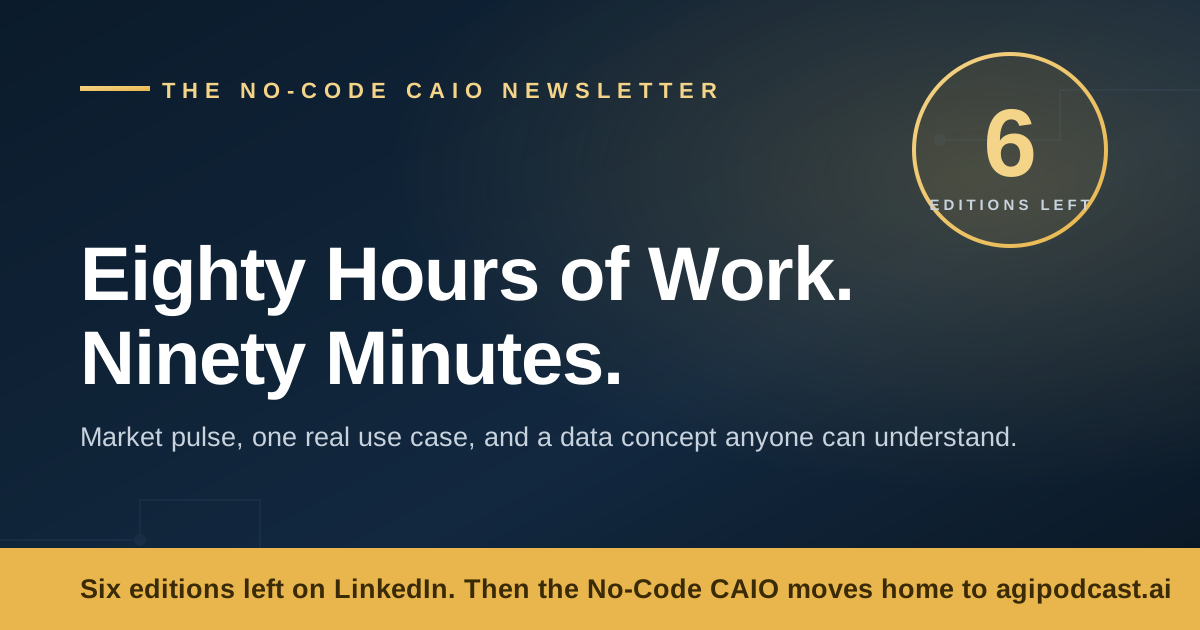
This is number six on the countdown. Six editions left on LinkedIn, and then the No-Code CAIO stops publishing there. Do not worry, it keeps going. It just moves to where I own the front door, so no algorithm gets to decide whether it reaches you.
You are already in the right place. If a friend still catches this on LinkedIn, do them a favor and send them here before the countdown runs out.
Keep your mind curious and your prompts clever.
Jason (human in the loop) Padgett